Xiamen Tmax Battery Equipments Limited was set up as a manufacturer in 1995, dealing with Laboratory equipments, technology, etc. We have total manufacturing facilities of around 2, 000 square meters and more than 100 staff. Owning a group of experie-nced engineers and staffs, we can bring you not only reliable products and technology, but also excellent services and real value you will expect and enjoy.
Sputtering Coating Machine: A Comprehensive Introduction to Advanced Thin-Film Deposition Equipment
Overview
A Sputtering Coating Machine is a highly advanced piece of vacuum deposition equipment used for applying thin, uniform films of metal or compound materials onto various substrates. Based on the physical vapor deposition (PVD) principle, this machine utilizes plasma-assisted sputtering to transfer atoms from a solid target to a substrate surface. Due to its excellent controllability, repeatability, and compatibility with a wide range of materials, the sputtering coating machine has become an essential tool in research laboratories, pilot production lines, and large-scale industrial manufacturing. It is widely applied in electronics, optics, energy storage, and surface engineering fields where precise film quality is critical.
Key Features
Modern sputtering coating machines are designed with robust mechanical structures and intelligent control systems to ensure stable operation and high deposition accuracy. A high-vacuum chamber is a core feature, typically equipped with multi-stage pumping systems to achieve ultra-clean environments and minimize contamination.
Most machines support multiple sputtering modes, including DC sputtering, RF sputtering, and magnetron sputtering, allowing both conductive and non-conductive targets to be processed efficiently. Advanced gas flow controllers precisely regulate inert and reactive gases, ensuring consistent plasma conditions. User-friendly interfaces, such as PLC or touchscreen control panels, enable operators to monitor and adjust parameters including power, pressure, deposition time, and substrate temperature in real time. Optional features such as substrate rotation, heating, and multi-target configuration further enhance coating uniformity and production flexibility.
Working Principle and Coating Process
The sputtering coating process begins with loading the substrates and target materials into the vacuum chamber. After sealing the chamber, the system evacuates air to reach the required base pressure. An inert gas, most commonly argon, is then introduced into the chamber at a controlled flow rate.
When electrical power is applied to the target, the argon gas becomes ionized, forming a plasma. Positively charged argon ions are accelerated toward the negatively charged target, causing atoms to be physically ejected from the target surface. These atoms travel through the vacuum and condense onto the substrate, forming a dense and uniform thin film.
By adjusting parameters such as sputtering power, gas pressure, target composition, and deposition time, the sputtering coating machine can precisely control film thickness, microstructure, and surface properties. This high level of process control makes sputtering suitable for both experimental development and mass production.
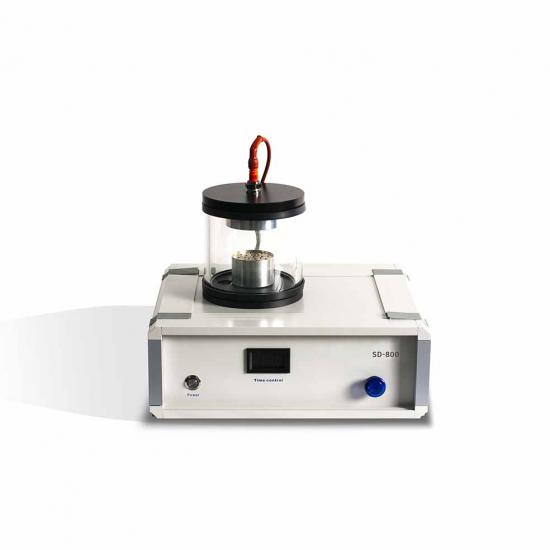
DC Sputtering Coater
Applications
The Sputtering Coating Machine is extensively used across a wide range of industries. In the semiconductor and microelectronics sectors, it is employed to deposit conductive layers, diffusion barriers, and electrode films on wafers and electronic components. In the optical industry, sputtering coating machines are used to produce high-quality reflective, anti-reflective, and optical interference coatings on lenses, glass, and mirrors.
In energy-related applications, sputtering technology plays a vital role in the fabrication of thin-film solar cells, fuel cells, and battery electrodes. It is also widely used in the production of functional coatings for displays, touch panels, sensors, and medical devices. Additionally, sputtering coating machines are commonly utilized in research institutions for material science studies and prototype development.
Advantages
One of the major advantages of a sputtering coating machine is its ability to produce coatings with excellent uniformity, density, and adhesion, even on complex or irregular substrate surfaces. Compared to other coating methods, sputtering offers superior film quality and strong bonding at relatively low substrate temperatures.
Another key benefit is material versatility. A wide range of metals, alloys, oxides, and nitrides can be deposited using a single machine. The process is highly repeatable and scalable, making it suitable for both laboratory research and industrial production. Furthermore, the closed vacuum environment ensures a clean and environmentally friendly coating process with minimal waste.
Conclusion
In conclusion, the Sputtering Coating Machine is a powerful and reliable thin-film deposition system that supports advanced manufacturing and scientific research. With its precise process control, flexible configuration, and broad application range, it remains a cornerstone technology in modern surface engineering and thin-film fabrication industries.