Xiamen Tmax Battery Equipments Limited was set up as a manufacturer in 1995, dealing with Laboratory equipments, technology, etc. We have total manufacturing facilities of around 2, 000 square meters and more than 100 staff. Owning a group of experie-nced engineers and staffs, we can bring you not only reliable products and technology, but also excellent services and real value you will expect and enjoy.
Microwave Furnace: An Advanced Thermal Processing System for Modern Industry
The Microwave Furnace represents a significant technological advancement in thermal processing, combining electromagnetic heating principles with precision mechanical engineering to deliver rapid, efficient, and highly controlled heating environments. Unlike conventional furnaces that rely on conduction, convection, or radiant heat transfer, the microwave furnace utilizes high-frequency electromagnetic waves to generate heat within the material itself. This volumetric heating capability dramatically improves energy efficiency, reduces processing time, and enables unique material transformations unattainable through traditional methods.
At the core of the microwave furnace is the principle of microwave dielectric heating. Operating typically at industrial frequencies of 2.45 GHz or 915 MHz, the system excites polar molecules and ionic species inside the target material. The oscillation of these molecules under the microwave field produces internal friction and, consequently, rapid heat generation. This mechanism allows microwaves to penetrate deep into ceramics, composites, polymers, and certain metallic powders, enabling uniform temperature profiles and minimizing thermal gradients that often cause stress or cracking in conventional systems.
A standard microwave furnace consists of several key components, engineered with precision to ensure stable and safe operation. The microwave generator, usually a magnetron or solid-state microwave power module, converts electrical energy into controlled microwave radiation. The energy is then transmitted through a waveguide system, which directs and shapes the electromagnetic field before delivering it to the furnace chamber. To achieve uniform heating, many designs incorporate mode stirrers or rotating platforms that continuously alter the field distribution, preventing hot spots and optimizing thermal uniformity across the load.
The furnace chamber itself is constructed from high-temperature refractory materials and lined with microwave-transparent insulation. These materials—often advanced ceramics such as alumina or silicon carbide—are engineered to withstand extreme temperatures while maintaining minimal microwave absorption. The chamber's geometry and the precise placement of field-modifying components are critical to achieving stable field patterns and efficient energy coupling with the material being processed.
Modern microwave furnaces also integrate advanced temperature control systems. Infrared sensors, fiber-optic probes, and thermal imaging allow the furnace to measure temperature without interfering with the microwave field. Coupled with microprocessor-based controllers, the system can regulate heating profiles with exceptional accuracy, supporting complex sintering curves, rapid ramping, and controlled cooling sequences. This high level of control is invaluable for applications such as ceramic sintering, powder metallurgy, catalyst preparation, and advanced materials research.
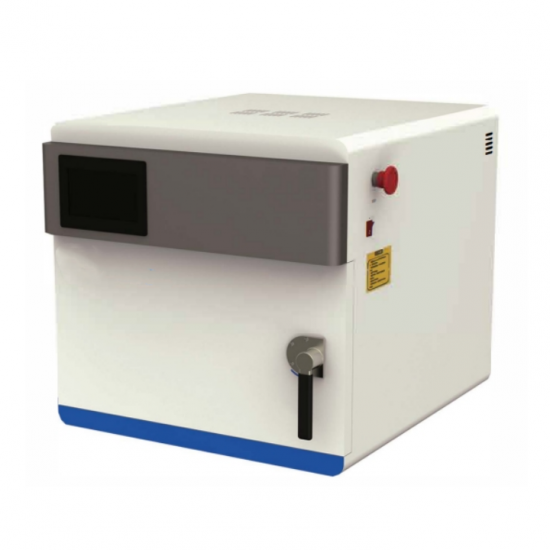
Microwave Muffle Furnace
One of the major engineering advantages of microwave furnaces is their energy efficiency. Because heat is generated internally rather than transferred from an external source, energy losses to the environment are significantly reduced. Additionally, microwave processing often achieves target temperatures faster, lowering overall process cycle times. These characteristics not only reduce operational costs but also contribute to improved product quality, as shorter exposure to high temperatures reduces grain growth and enhances microstructural uniformity.
Safety remains a crucial design aspect. Microwave furnaces incorporate interlock systems, shielding structures, and electromagnetic sealing technologies to prevent leakage of microwave radiation. Multi-layered metal enclosures and precision-engineered door seals ensure compliance with industrial safety standards. Cooling systems—often featuring forced-air or water-cooling circuits—protect the magnetron, electronics, and structural components from thermal stress during prolonged high-temperature operation.
In industrial practice, microwave furnaces are used in applications ranging from laboratory-scale experimentation to large-scale manufacturing. Their ability to process advanced ceramics, high-purity materials, composite structures, and specialty powders makes them indispensable in fields such as aerospace, electronics, biomedical engineering, and energy storage material development.
In summary, the Microwave Furnace is a highly efficient, technologically sophisticated heating system that offers rapid processing, uniform temperature distribution, and exceptional control. Its integration of electromagnetic engineering with advanced mechanical design positions it as a cornerstone in the evolving landscape of high-performance material processing.